How to manage an IP licensing portfolio
Most IP licensing tools end at signature. Here's what managing a portfolio actually requires for the next ten years.
Most IP licensing tools end at signature. The work begins there.
Talk to anyone who runs an active IP licensing programme and you’ll hear the same story. The licence took six months to negotiate. Lawyers argued over the royalty rate, the minimum guarantee, the audit threshold, the field of use. Eventually it was signed. Everyone celebrated.
And then it sat there for ten years.
Or rather, it sat there for ten years across a SharePoint folder no one fully owned, a spreadsheet maintained by someone who left in 2022, and five different email threads. The royalty reports came in quarterly, mostly. The sublicence requests came in by email. Renewal windows opened and closed. Audit thresholds got breached and nobody noticed for two years.
That’s the actual problem with IP licensing portfolio management. Not the negotiation. The decade that comes after it.
If you’re running a portfolio of 50 to 300 active licences, you already know this. You’re not short of tools that help you draft a licence. You’re short of tools that help you live with one.
The decade after signature
The negotiation is the easy bit. Everyone knows when the deal closed. The signature is on file. Nobody disputes that.
What happens next is where licensors quietly lose money.
Royalty reports come in. They might be late. They might be wrong. Without a forecast to compare them against, you don’t know either way. The licensee reports £180,000 in net sales for Q2. You can’t tell if that’s the truth, a guess, or a deliberate undercount. So you accept it. So does every other licensor in your portfolio.
Royalty audits are expensive and adversarial, so you do one or two a year out of fifty active licences. That’s the audit lottery, and the licensees know it.
Sublicences happen. Sometimes you get asked. Sometimes you don’t. The licence requires your prior written consent, but the sublicence chain has three tiers and the second-tier distributor never made it to your desk.
Renewal windows have a 90-day notice period before they auto-renew. Miss the window and you’ve extended the licence by another five years at terms you signed in 2019.
Minimum guarantees come due. Some get paid, some get disputed, some get quietly recouped against future royalties at terms you’d forgotten existed.
Every one of these is a discrete event the platform should be handling. Almost none of them are happening in a platform at all.
Why most tools miss
There are tools on the market. They mostly fail in one of three ways.
The first failure: they’re single-sided. They serve the licensor, or they serve the licensee, but never both. Which means the licensee submits royalty reports into your platform via a CSV export from their platform, and the chain of custody is a spreadsheet that lived in Outlook for three months. You’re not managing a relationship. You’re reconciling two databases that don’t talk to each other.
The second failure: they stop at signature. The platform helps you negotiate the deal. Once it closes, the platform’s job is done. You’re back to spreadsheets for the next ten years.
The third failure: they don’t compound from your past deals. The new licence you’re drafting in Q3 has no idea what you charged last year, what you conceded six months ago, or what the standard is across your portfolio. Every negotiation starts from scratch, even when you’ve signed two hundred similar deals.
You can’t manage a portfolio with tools that treat each licence as a fresh document.
What actually works
Two things have to be true for an IP licensing platform to work over a ten-year licence.
Both sides in the same record.
The licensor and the licensee both work in the same workspace. When the licensee submits a royalty report, the licensor sees the number as it’s entered. When the licensee requests a sublicence, the licensor sees the request in their inbox the same hour. When a breach is raised, the audit trail is visible to both parties from the moment it’s filed.
No CSV exports. No email chains. No version-4-final-final-2.docx. The licence is a record, not a file, and both parties are inside it.
That’s the bit that fixes IP licensing contract negotiation too. Drafts move between licensor and licensee with possession tracked. Every redline is recorded against the version. Once the licence is signed, the same record carries the relationship forward. The same problem we wrote about for UK funding rounds applies here: version control in a Word document is not a workflow.
AI grounded in your own portfolio.
A new licence comes across your desk. The royalty rate is 5%. Your portfolio standard is 8%. A generic legal AI tool won’t notice. It doesn’t know your portfolio. It’s trained on the open internet.
A platform that has read every licence you’ve ever signed will flag it before you reach for a pen. Royalty rate down. Territory excludes Switzerland. Sublicensing without your consent. Three concessions caught in the time it takes to open the document.
Every new clause checked against every clause you’ve ever signed. Every concession flagged before signature. That’s the second pillar, and it’s the bit that compounds.
What you should be tracking
A portfolio management platform has to handle the full lifecycle, not just the document. In practice:
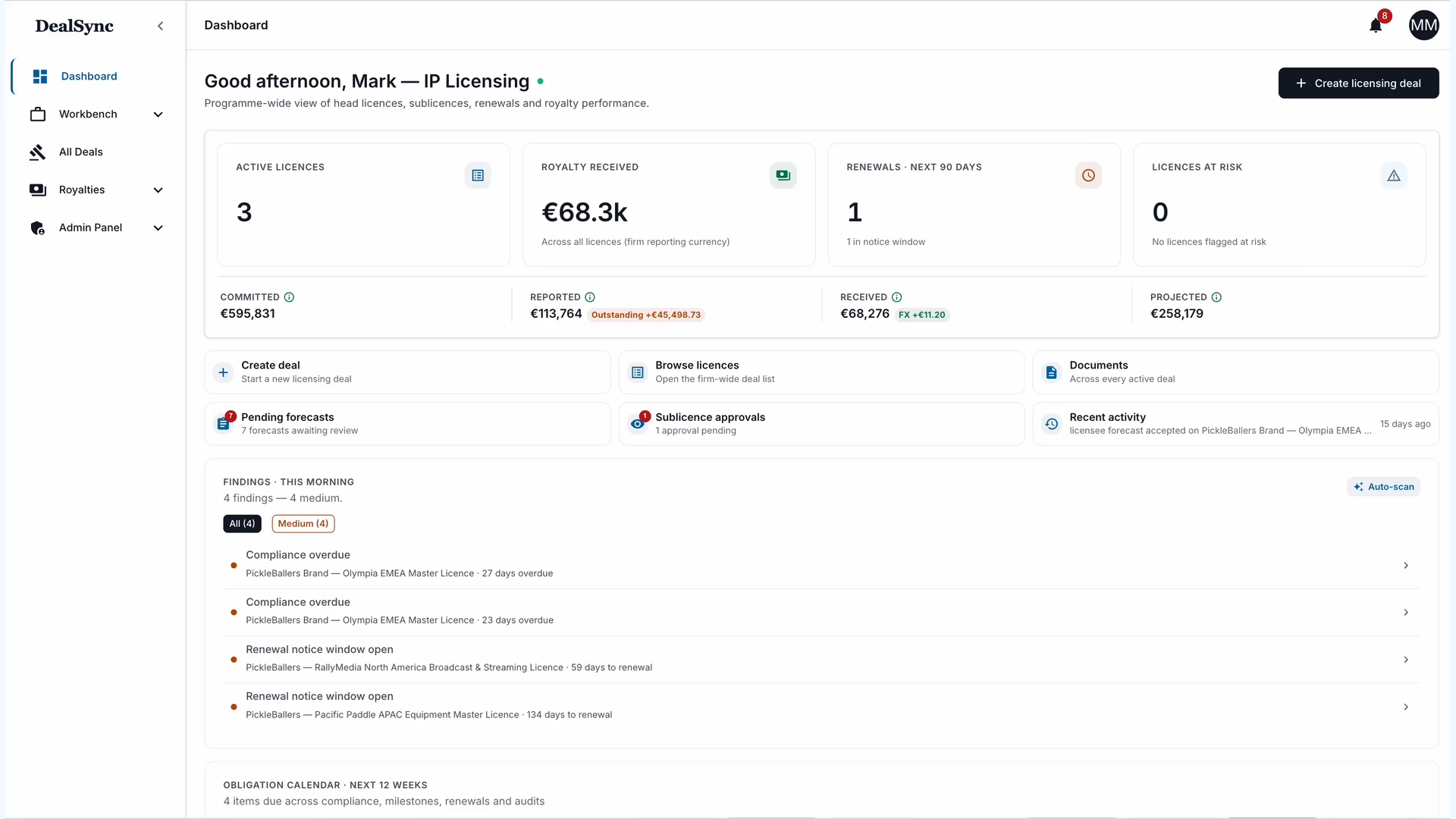
- Royalty terms: rate type (flat, tiered, per-unit), royalty base (net sales, gross revenue), minimum guarantee, advance, audit threshold, recoupment rules. All structured. All queryable across the portfolio.
- Licensee forecasts versus reported royalty: licensees submit projections, the platform reconciles those projections against actual reports as they come in. Variance gets flagged automatically.
- Sublicence approval queue: every sublicence requires your prior written consent. Requests route to the licensor, get approved or rejected with a reason, and sit in the audit trail forever.
- Breach notices with audit trail: either party can raise a notice. The audit trail records who raised it, when, what was provided as evidence, when the cure period started, whether the cure was accepted.
- Renewal calendar: every licence has a renewal notice window. The platform tracks when those open, when they close, and what the default is if you miss them.
- Territory, field of use, and exclusivity: per scope, per rights grant. Apparel in France is a different scope from footwear in Germany, and the platform knows.
The point is not that any one of these is novel. The point is that they all exist in one record, for both parties, across the ten-year life of the licence.
Why a portfolio gets stronger
A portfolio is a moat. It gets bigger every time you sign a deal.
Every new licence teaches the platform what your firm’s standard looks like. The third time a licensee tries to slip in a 5% royalty rate, the AI catches it instantly because it’s seen the previous two attempts. The fifth time someone asks for a Switzerland carve-out, the platform knows your default is to refuse.
Generic legal AI gets smarter the more law it reads. A portfolio platform gets smarter the more of your law it reads. The difference matters.
Three years in, you stop negotiating from scratch. You’re negotiating from a position of authority. Your past deals are your floor.
Related reading
If you also negotiate the licences themselves, the same two-sided workflow applies pre-signature. We’ve written about why UK funding rounds still run on email and track changes and constrained autonomy on a live VC round or M&A book for the broader picture.
If you’re managing a portfolio
DealSync’s IP licensing platform is built around this. Both sides of every IP licence work in one record. The AI is grounded in your portfolio, not the open internet. Royalty reports reconcile against forecasts in real time. Sublicences route to the licensor. Renewal windows trigger reminders before they close. Audit thresholds fire automatically when variance crosses them.
We’re early. We’re building it with brand owners running real portfolios, not against a feature list someone wrote in a meeting.
If you’re managing an IP licensing portfolio, on either side of the table, I’d love to hear how you’re doing it today. The honest answers tend to be more interesting than the polished ones.
Mark Marley is the founder of DealSync. Connect on LinkedIn.